
Posted on May 20, 2022 in
Business
Last updated: September 8, 2026
Becoming an education assistant is a great career choice. You can influence the lives of students and inspire them to better themselves, that’s why the role of an education assistant is crucial to the classroom environment and to the success of the students themselves.
There’s a lot of work involved that teachers cannot always handle, which is then given responsibility to the education assistant, or EA. Being an EA can be an exciting and rewarding career as you will get the opportunity to work with different types of students who have different needs, and educators who have alternate ways of teaching. It will make you a well rounded individual both on the personal and professional level.
So what does it take to become an education assistant? In this blog, we’ll go over how to become an education assistant in Canada, as well as how much an education assistant gets paid by province or territory.
There’s many tasks that an education assistant can take care of. Their responsibilities can range from teaching-related duties to play time activities to supervision. The undertakings can depend on the circumstances and needs of the school or the classroom in question.
What does an Education Assistant do?
Key responsibilities of an education assistant are:
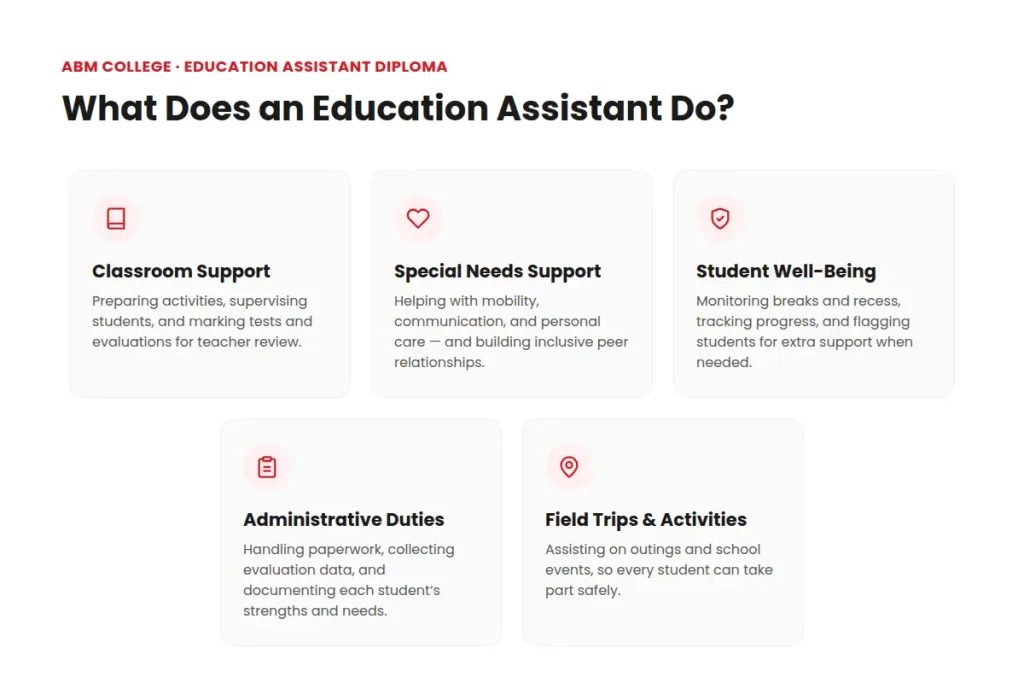
- Making sure the class is prepared for activities
- Helping students and supervising them
- Monitoring the behaviour of students
- Taking care of paperwork
- Collecting student evaluation data
- Marking tests for teachers’ review
- Documenting pupils’ strengths and weaknesses
- Assisting in field trips and other events and activities
There are certain traits and qualities that you should possess to become a successful education assistant. These include being flexible, having patience, creativity, high tolerance level, sensitive to those around you, and a positive attitude. As well, you should have good health and physical fitness.
Supporting students with special needs. Education assistants play a particularly important role for students with special needs — helping with mobility, facilitating communication, and supporting personal care needs. They also help these students build peer relationships and navigate the school environment, contributing to a more inclusive classroom for everyone.
Supporting student well-being. Beyond academics, education assistants monitor students during breaks and recess to help keep them safe, encourage healthy peer relationships, and keep records of each student’s progress. Based on what they observe, an EA may also flag a student for additional support services, such as speech therapy or counselling.
Employment Opportunities
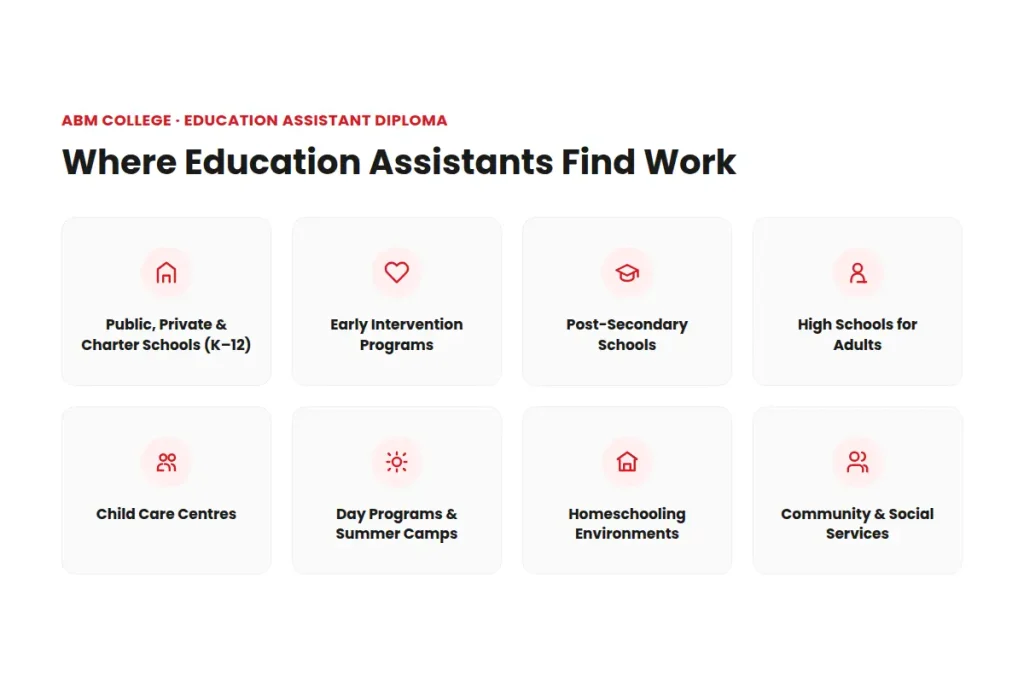
Working as an education assistant goes beyond the classroom. There are many different types of areas where they can work, and these include:
- Private, public, and charter schools from kindergarten to grade 12
- Early intervention programs
- Post-secondary schools
- High schools for adults
- Child care centers
- Day programs and summer camps
- Homeschooling environments
- After school programs
- Other social services where education is offered
You can work at the capacity you’re comfortable with since there are both full time and part time opportunities and jobs available.
As an education assistant, you might be worried whether there’s room for you in the market. While there is a decent amount of competition in the field, you can get into the workforce easily with an education assistant course online in Canada.
According to ALIS, the occupational group for elementary and secondary school teacher’s assistants was projected to grow nearly 2 percent from 2019 to 2023. Job openings were created by employee turnover, and 290 new positions were or will be generated during this time frame annually. As well, 70 percent of recruiters for this role hired education assistant professionals in the past two years.
Since jobs are growing, there are lots of chances for you to find fulfillment and decent employment prospects. You can take an education assistant program online, in person, or mixed training to increase your chances of finding beneficial employment that will help you in the future.
What Qualifications Do You Need to Become an Education Assistant?
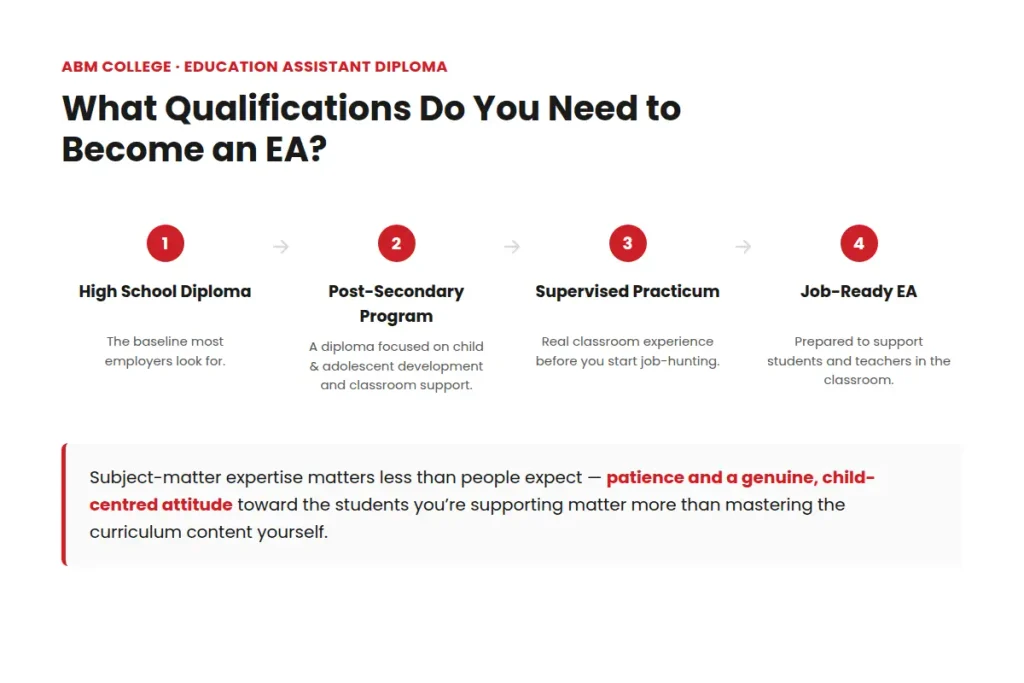
Most employers look for a high school diploma plus a related post-secondary program — and a program that includes a supervised practicum is a meaningful advantage, since it gives you real classroom experience before you’re job-hunting.
Subject-matter expertise matters less than people sometimes expect. As one ABM College Education Assistant instructor puts it, the role isn’t really about being the most knowledgeable person in the room — patience and a genuine, child-centred attitude toward the students you’re supporting matter more than mastering the curriculum content yourself.
How Much Does an Education Assistant Get Paid?
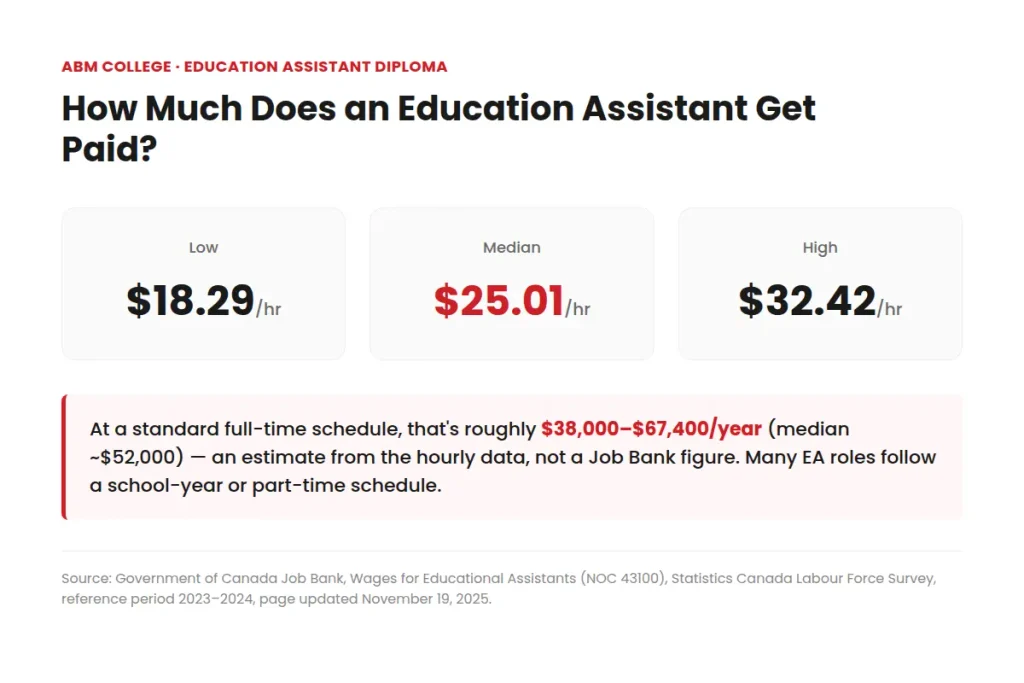
Wages vary by employer, region, and experience, but Job Bank’s most recent data for Education Assistants (NOC 43100) gives a clear national picture: hourly wages across Canada range from $18.29 to $32.42, with a median rate of $25.01/hour. At a standard full-time schedule, that works out to roughly $38,000–$67,400 per year (median around $52,000) — figures we’re estimating from the hourly data, not numbers Job Bank publishes directly, so they’re presented here as an approximation rather than a guarantee. Many education assistant roles follow a school-year calendar or a part-time schedule rather than full-time, year-round work, so treat the annual figures as an upper-bound estimate rather than a typical paycheque.
Source: Government of Canada Job Bank, Wages for Educational Assistants (NOC 43100), Statistics Canada Labour Force Survey, reference period 2023–2024, page updated November 19, 2025 — jobbank.gc.ca.
How to Become an Education Assistant in Canada
Enrolling in an EA diploma program in Canada is the fastest and easiest way to become one. It will prepare you for all the aforementioned duties that you will be in charge of while giving you additional training where needed, such as having a mandatory practicum at the end so you can get real-life experience.
The education assistant course will not only teach you how to do the tasks, but also inform you of practical studies in child and adolescent development, curriculum development, assessment and behavioral management, along with key computer software skills.
In nearly every province and territory, the process to become an education assistant is the same. It is often necessary to complete one year post-secondary education and receive a certificate in the field to find a job in this role. Employers are more likely to hire you, have confidence in your skills, and trust that you can do the job.
ABM College’s online education assistant program in Alberta will give you the appropriate skills and training that you need. The program is online, so you have the freedom to take your classes from wherever you are in the country.
Graduates of ABM College’s program also receive free employment assistance for up to one year after graduation, to support the job search process.
Need to prepare for your EA job interview?
Read more or contact us today for more information.
About The Author

Kiran Vijay leads SEO at ABM College, working alongside admissions advisors and program teams across the Calgary, Winnipeg, and Toronto campuses. With 10+ years in SEO, paid search, and content strategy for Canadian post-secondary education, Kiran writes about diploma programs, career outcomes, and the job market for career college graduates — grounded in ABM College’s own enrolment and graduate employment data reported to Alberta Advanced Education. Connect on LinkedIn.